Case study
llmde
AI-assisted data extraction for systematic reviews, with every value traceable to the page and quote it came from.
A language-model extraction pipeline for a systematic review and meta-analysis, built so that every value carries its page and quotation and a human reviewer keeps the last word.
What it does
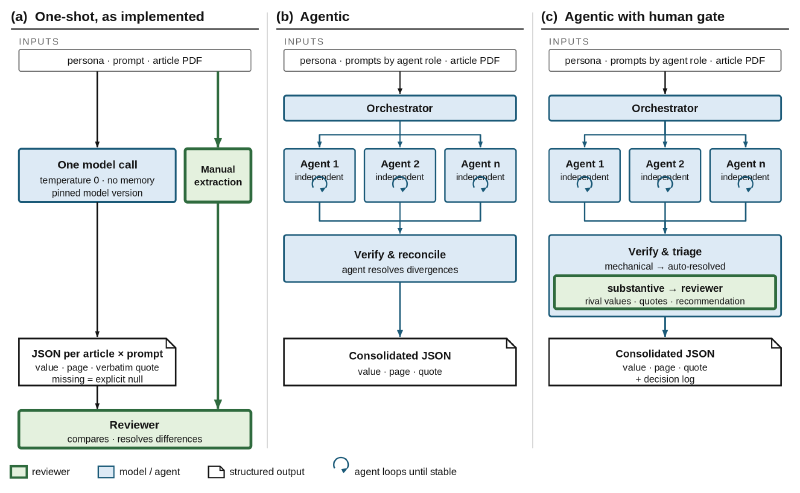
Extracting study data from 39 trials by hand is slow and inconsistent between readers. llmde hands the mechanical part to a language model under strict rules: extract exactly, never interpret, return an explicit null for anything unreported, and cite the page and quote behind every value.
How the prompts were built
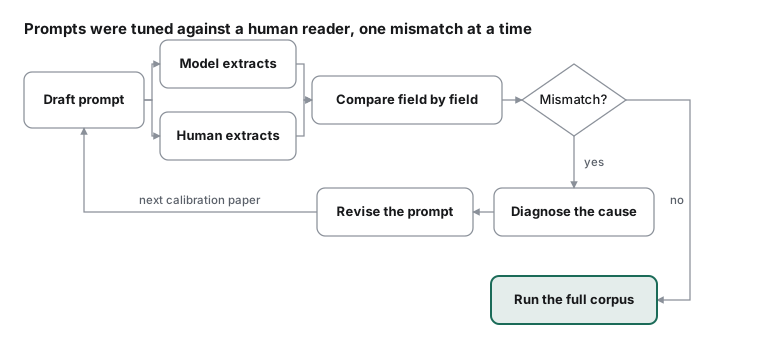
Each prompt was drafted, run on two or three deliberately varied papers in parallel with a human reader, and revised wherever the two disagreed. Mismatches were diagnosed before anything was changed, since most came from a definition with two readings or a reporting variant with no rule.
What came out
- Duplicate extraction. 39 trials for the review and 19 for the meta-analysis, once by hand and once by the model (Claude Opus 4.6), reconciled by discussion, with 97% precision for the model against the manual extraction.
- Open-source package. llmde on GitHub, MIT licence: five extraction prompts, one system instruction, Claude and Gemini backends, a batch CLI that resumes interrupted runs.
- Written method. Chapter 5 of the thesis: the single-call design next to two agentic alternatives, with a case for keeping a human gate.
My role
I led the project: I designed the extraction method and co-wrote the prompts and schemas, and Mathieu Scheltienne implemented them as the package. I ran the model side of the duplicate extraction and reconciled it with the manual side.
What this shows
- LLM workflows designed with verification built in: evidence trail, explicit nulls, structural checks, pinned model version.
- Evidence-synthesis method: duplicate extraction and calibration on a pilot sample, as review guidance recommends.
- Specifying a method precisely enough for an engineer to turn it into a reusable tool.