Case study
Eco-Rescue
An action-like video game that trains attentional control in anxious adolescents, now in a three-site randomised trial.
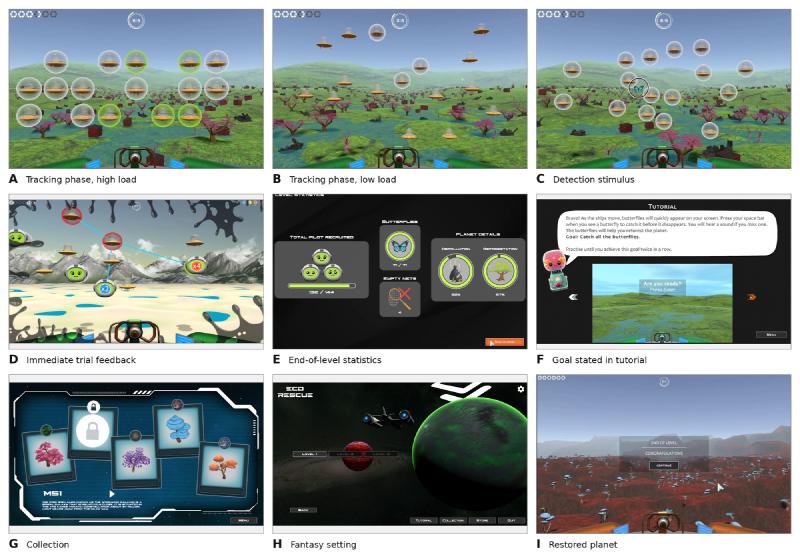
A cognitive-training game that wraps a multiple-object-tracking task in a planet-restoration story, adapts its difficulty to each player, and is now being tested in a three-site randomised trial with anxious adolescents.
What it is
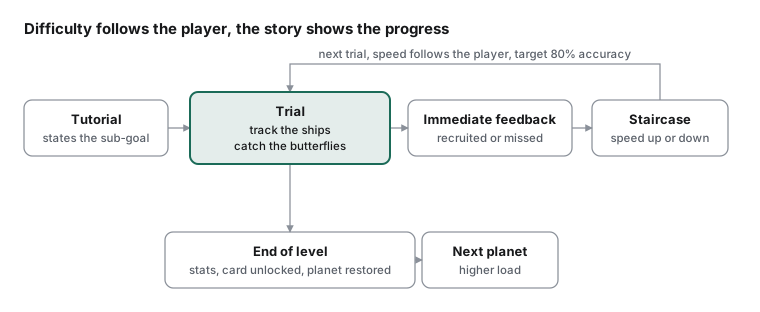
Eco-Rescue is played from a third-person view on a PC. The player is a pilot who recruits a planet’s residents and catches butterflies to depollute and reforest it. Underneath, every trial is a multiple-object-tracking task with a concurrent detection task: track the ships carrying residents with happy, angry or neutral faces, and press a key the moment a butterfly appears. A three-up one-down staircase adjusts the ships’ speed to keep each player near 80% accuracy, so difficulty follows the player’s own learning curve.
How the design works
The tutorial states each sub-goal in words before play. Every trial closes with immediate feedback, recruited ships in green and missed ones in red, and every level with statistics, an unlocked card about a real astronomical object and a visibly restored planet. The number of ships and distractors changes from trial to trial, and the butterfly appears where and when the player cannot predict, so performance never becomes automatic. The story was chosen for adolescents, who are particularly concerned by climate change, and stays out of the trained trials themselves so that it does not compete with the task.
What came out
- The game. Ten design principles across five classes (challenge, feedback, goals, resources, storytelling), coded against the taxonomy from my systematic review of 25 mental-health games.
- The trial. A three-arm randomised controlled trial, Eco-Rescue against Bejeweled 3 and no training, planned for 150 adolescents aged 11 to 15 with elevated anxiety, 12 hours of play over six weeks at home, run in Geneva, Haifa and Miami, with completion expected by the end of 2027.
- The redesign brief. From the review and the meta-analysis, two changes proposed for a next version: a deeper, persistent narrative delivered between trials rather than during them, and a more embodied input, each to be tested against the current version.
My role
I co-designed the game with Swann Pichon and Daphné Bavelier at Campus Biotech, from the mapping of the tracking paradigm onto a game mechanic to the adaptive difficulty, feedback and story. I then led the implementation of the trial that evaluates it, wrote the first draft of the published protocol, and take part in recruitment across the three sites.
What this shows
- Turning a laboratory paradigm into a game mechanic without losing the operation it trains.
- Adaptive difficulty and feedback design grounded in learning science, with built-in variability against boredom.
- Designing for a clinical population: a story adolescents relate to, kept out of the trials where it would compete with the task.
- Carrying a game from design into a multi-site clinical trial.